top of page


A Movie? - Why not?
Sometimes, when I look at a painting or hold an object in my hands, I fall into a dreamlike state. I dream of long-ago events, faraway people, and objects that are close and dear. These dreams are like movies. One day, I will make one of these movies real. Perhaps this one, about a Kamakura Kintsugi teabowl. Title Dreams in Clay 陶器の夢 Logline At fourteen, far from home and toiling in a pottery shop in Tokyo’s prestigious Ginza, young Kuroda Ryoji dreams of owning his own shop


Manners, Money, and Modernity.
In reply to a telegram the Iemoto dips his brush in ink and writes this beautiful, well-spaced, but humble letter about manners, money, and modernity. Zui'o Sosa (1837-1910), Letter to Takeyama Kanshichi (1854-1907), Ink on paper, 54 x 103 cm (21 ¼ x 40¾ in.) Mounting 50.5 x 165 cm (19¾ x 65 in.) The Meiji Restoration of 1868 was a turning point. And tea culture went through a period of decline. One of the reasons for this was the fact the supportive classes, the feudal lords


Perfection is Nonsense
In Japan, when prized ceramics, especially those associated with chanoyu (the tea ceremony), were broken or damaged, they would be mended using lacquer that was often further embellished with gold or silver. Such repairs can have inherent artistic value, while imparting prestige to a vessel and its owner. Amusing, amazing and adorable stands this flat dish in front of you. It is self-assured like somebody who is proud of his scars, showing the souvenirs of his turbulent biogr


Creating without idling is rare and praiseworthy. - Do not give up!
This letter is about fish and poetry, about gratitude and sorrow. Ishikawa Jozan was a prominent Samurai recluse, garden designer, and literatus but he also was a teacher. And one of his students was Tsuda Masazane, an influential statesman with a serious hobby. I respectfully read your letter written on the eighth day of this month. And for the ten mackerels from Noto [mackerel is a signature product from Noto. As is tea from Uji or Sake from Itami, and not to mention Whale


Birds, Boats, and Cherry Blossom
Karsumaru Mitsuhiro was a distinguished poet and a major figure in the inner circles of Emperor Go-Mizunoo. Karasumaru Mitsuhiro, offspring of a wealthy Kyoto family was a master of poetry, calligraphy, and tea ceremony. On this scroll he put together three poems about famous places and views in and near Osaka. – The poems are written in a rather casual style giving these lines a private feel as if they were done just for himself. At Suminoe on the ebb tide and the sea is fa


Beyond Failure or Success
Kodojin - the Old Taoist - was both a poet and a painter. And he is remembered as being one of the last in a long line of literati artists in Japan. He led a rather quiet and reflective life of study, but his poetry and paintings are dramatic and unconventional. His landscapes are always unusual, mostly eccentric, and sometimes psychedelic. Nevertheless, he originally was «noted more for his poetry than his painting, Kodojin set the tone for his landscapes through his inscrip
Monumental Fragility
An ambiguous tea bowl. It is monumental and in the same time it is shy, reclusive, and fragile. Rengetsu delicately finger-pinched the body of this bowl, and subtly brushed the poem as well as the pine decoration in dark brown paint on light brown clay. And as if done on purpose the old gold lacquer repairs (kintsugi) underline the humble tones of this great piece. In the future happiness and long life - two sprouting leaves to grow a thousand years. Otagaki Rengetsu (1791-18


More than Zen and pickled radish
Takuan Soho was the prototypical early Edo monk scholar with a sharp, witty, and untamed spirit. Dressed in a monk’s robe he pursued erudition in the broadest sense. He not only studied Buddhist texts but also the Chinese classics. Takuan also excelled in various arts. He was a painter, poet, writer, calligrapher, gardener, and a tea master. And he was the advisor, confidant, and the teacher of noblemen, among them the famous swordsman Yagyu Munenori and, some say the legenda


An expression of respect, esteem, and gratitude by Matsumura Keibun... and about mending an umbrella
No doubt that Shibata Zeshin was the most prominent lacquer artist of the nineteenth century. And Ikeda Taishin (1825–1903) was his most accomplished and most promising student. But in February of 1856 he left. Taishin left his master, his workshop, his master's house where he has been living for mor than twenty years. And Taishin left for his Grand Tour. A year later he returned and established his own studio in Asakusa, just around the corner from Zeshin. Taishin's first st


The mountains shout
If one day you would want to get away from your fancy, feverish, frantic urban life, where would you go? Where would you hope to find a remote, quiet, and contemplative place? - Maybe in the mountains. For centuries, the mountains offered all the blessings a civilized human being was longing for. But Deiryu experienced something completely different. On this tea bowl he draws a different picture. He has written a so called “One Word Barrier” (Jap.: ichiji kan), a form of a Ze
Joyful memories
Rengetsu’s life slowed down at around the age of 75. The long years of travelling, moving, and drifting came to an end in the small...


Das Geheimnis verbirgt sich manchmal auf dem schwarzen Grund einer Teeschale
Allem Sammeln liegt eine kaum zähmbare Leidenschaft zugrunde. Warum aber gerade Keramik? Und warum ausgerechnet deformierte Keramiken aus...
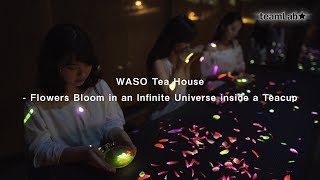
Flowers Bloom in an Infinite Universe inside a Teacup
When tea is poured into a teacup flowers bloom inside the cup. Move the teacup or pick it up and all of the flower petals scatter and...


The Centuries-Old Japanese Tradition of Mending Broken Ceramics with Gold
Some four or five centuries ago in Japan, a lavish technique emerged for repairing broken ceramics. Artisans began using lacquer and gold pi


A Display of 8000 Paper Sculptures Made from Chopstick Sleeves
Yuki Tatsumi was working as a waiter in a restaurant when one day, as he was cleaning up a table, he noticed that a customer had intricately folded up the paper chopstick sleeve and left it behind. Japan doesn’t have a culture of tipping but Tatsumi imagined that this was a discreet , subconscious method of showing appreciation. He began paying attention and sure enough noticed that other customers were doing the same thing. Tatsumi began collecting these “tips” which eventua


Schönheit trinken. Warum ich mich neuerdings für Teeschalen begeistere – ein Besuch im Keramikmuseum
Von Marion Poschmann Töpfern – damit verbindet man hierzulande Volkshochschulkurse für gelangweilte Hausfrauen, Reha-Angebote, Beschäftigungstherapie. Damit traktiert man Schüler, wenn ein Erlebnis kreativen Schaffens forciert werden soll, das keinerlei Voraussetzungen erfordert, denn Aschenbecher gelingen eigentlich immer. So voreingenommen betrat ich im vergangenen Jahr einen Museumssaal in Tokio, und ohne dass ich wusste, wie mir geschah, zog mich eine unsichtbare Kraft q


Cultivating Femininity: Women and Tea Culture in Edo and Meiji Japan by Rebecca Corbett
The overwhelming majority of tea practitioners in contemporary Japan are women, but there has been little discussion on their historical...
School of Life: MATSUO BASHO
"Matsuo Basho was one of the most famous Zen poets of Japan, who alerts us to the neglected beauty and interest of everyday life, and thereby reconciles us with our own circumstances." SCHOOL OF LIFE on youtube - This video has been posted two years ago but back then this blog didn't exist. - Also check this: Matsuo Basho | Poem


HAIKYO: THE MODERN RUINS OF JAPAN
With mazes of expressways pushing scores of traffic through action filled, neon lit cities, there is perhaps no better platform than Japan to grasp the full motion and machinery of life. But sitting silently in the shadows waits another realm. Just as intoxicating, enchanting and engaging as its counterpart albeit not as animated or ablaze with flashing lights, hundreds of abandoned abodes lay forgotten and left to decay. Stepping away from the lights and into the shadows,
RAKU KICHIZAEMON ON THE AVANT-GARDE TRADTITION OF RAKU WARE
Raku Kichizaemon, the fifteenth grand master of the Raku line of potters, creates avant-garde works of ceramic art rooted in 450 years of tradition. With a tea bowl of his own making in hand, he discusses the philosophical underpinnings of Raku ware.

BachmannEckenstein | JapaneseArt email@bachmanneckenstein.com +41 61 373-0624 Basel, Switzerland
bottom of page